POLLUX TECH
Defining the Next Generation of Maritime Safety through Novel Satellite Communication Infrastructure
Profile
Legal Name
POLLUX TECH IKE
Tagline
Defining the Next Generation of Maritime Safety through Novel Satellite Communication Infrastructure
Details
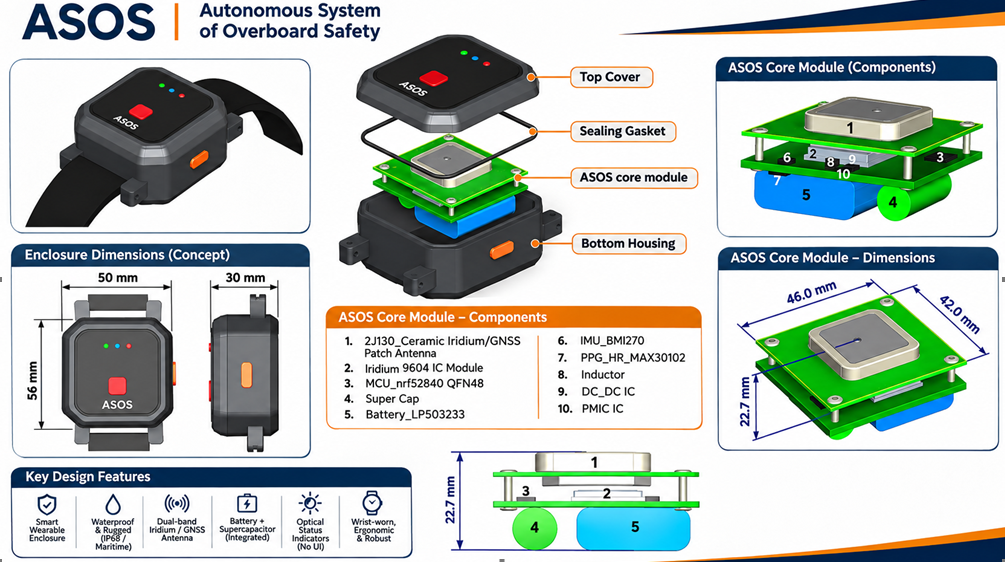
Pollux Tech delivers a dual-use, LEO-enabled maritime safety infrastructure layer that integrates high-precision GNSS positioning and satellite communications with international safety standards. By embedding low-latency Low Earth Orbit (LEO) connectivity directly into existing maritime safety governance frameworks (IMO / SOLAS Chapter III), the platform establishes a continuous, human-centric distress detection and alerting layer. To ensure rapid industrialization and strict regulatory compliance, Pollux Tech operates under key strategic partnerships: - Satellite Connectivity: Commercial agreement with Iridium leveraging its GMDSS-eligible LEO constellation for reliable global distress alerting. - Hardware Manufacturing: Industrial prototyping partnership with Prisma Electronics for aerospace-grade hardware production. - Classification & Certification: Operational alignment with the french classification society for type approval and compliance with SOLAS, the LSA Code, and applicable IMO Resolutions. This integrated architecture fills critical coverage gaps in legacy systems, dramatically shortening response times for Man Overboard (MOB) events and enhancing Search and Rescue (SAR) operational resilience across commercial shipping and defense fleets.
Classification
Type
Private Company - SME
Size
Micro (1–9)
Category
PNT/GNSS & Navigation Subsystems, Space Systems & Subsystems
Value Chain Position
Downstream
Map
An interactive map showing the organisation's location will appear here.
Send Message
Your Name
Your Email
Subject
Your Message (optional)
Send Message
Contact
Website
https://pollux-tech.com
CONTACT Email
info@pollux-tech.com
CONTACT Phone
6947224912
Address
Dimokratias 34
Psychiko
Attica
Greece
154 52
International Presence
Strategic Focus
Strategic Priorities: Pollux Tech structures its strategic expansion across three core operational pillars: 1. Technology Infrastructure & LEO Integration Space-Segment Integration: Fully operationalize the commercial agreement with Iridium to route continuous, low-latency distress telemetry over its GMDSS-eligible LEO constellation. Hardware Industrialization: Complete aerospace-grade prototyping and scale production with Prisma Electronics to deliver ruggedized, marine-compliant wearable and vessel hardware. 2. Regulatory Compliance & Certification Statutory Type Approval: Advance classification and verification protocols alongside Bureau Veritas to achieve full compliance under SOLAS Chapter III, the International LSA Code, and relevant IMO Resolutions. Equivalence Pathways: Establish validated regulatory precedence for downstream LEO safety layers under SOLAS alternative design frameworks (Regulation III/38). 3. Commercial Scaling & Market Execution Dual-Use Deployment: Execute operational trials and fleet integration across merchant shipping fleets, offshore energy operators, and defense platforms. Ecosystem Integration: Embed the system as a core distress layer within national and international Search and Rescue (SAR) infrastructure.
Looking for Partnerships: Pollux Tech is actively seeking strategic partnerships, commercial collaborations, and technical joint ventures across the space, defence, and maritime sectors to accelerate system deployment, scale industrial production, and expand regulatory adoption. 1. Technical & Space Infrastructure Partners Satellite Operators & Constellation Providers: Providers of Low Earth Orbit (LEO) and Medium Earth Orbit (MEO) constellations offering distress-band (GMDSS-compatible), low-latency IoT, and direct-to-device (D2D) data connectivity to expand space-segment redundancy and downstream telemetry bandwidth. Payload & Antenna Manufacturers: Developers of low-profile, high-efficiency micro-antennas, space-grade RF front-ends, and ultra-low-power satellite transceivers tailored for miniaturized, ruggedized wearable units and marine hardware. 2. Industrial Manufacturing & Hardware Scaling Defense & Aerospace Electronics Manufacturers (EMS): Certified electronics manufacturing service providers specializing in MIL-STD and space-grade production for scaling high-volume assembly, conformal coating, surface-mount technology (SMT), and automated quality testing of marine distress wearables. 3. Maritime Fleet Operators & Commercial Pilot Partners Merchant Shipping & Commercial Fleet Managers: Ocean-going vessel operators (tankers, bulk carriers, container ships) and offshore energy fleets willing to conduct operational pilot trials, on-board vessel deployments, and crew safety testbeds. Offshore Energy & Marine Operations: Developers of offshore wind farms, oil and gas platform operators, and specialized marine service providers seeking real-time crew safety monitoring and emergency response integration. 4. Defence, Dual-Use & B2G Contractors Prime Defence Contractors & System Integrators: Defence suppliers seeking to integrate satellite-enabled, dual-use personnel safety and distress tracking technologies into broader naval, coast guard, and tactical domain awareness platforms. National SAR & Maritime Authorities: Public sector bodies interested in co-developing automated, LEO-assisted distress routing pathways direct to Maritime Rescue Coordination Centers (MRCCs).
Background
Established: 2026-01-08
Projects & Missions: • ASOS – development, prototype validation, and classification pathway engagement. • Institutional alignment with satellite service providers and maritime regulatory stakeholders.

Key Customers: Pollux Tech operates a B2B and B2G commercial model targeting commercial maritime fleets, dual-use defense operators, and maritime regulatory/SAR infrastructure end-users: 1. Commercial Maritime & Shipping Fleets Commercial Shipowners & Fleet Managers: Ship management companies across the ocean-going merchant shipping segment (tankers, bulk carriers, container vessels) adopting LEO-enabled safety infrastructure to enhance crew safety compliance and operational resilience for Man Overboard (MOB) response. Offshore Energy & Maritime Service Operators: Offshore supply vessel (OSV) operators, wind farm support vessel operators, and specialized maritime service providers requiring continuous, low-latency distress tracking in harsh offshore environments. 2. Public Sector, Defence & Security (B2G) Coast Guards & Search and Rescue (SAR) Agencies: National maritime safety authorities and SAR coordination centers seeking automated, continuous LEO distress telemetry to shorten rescue response windows and improve tactical coordination during distress events. Naval & Defence Forces: Defence and security operators adopting dual-use maritime safety systems integrated with satellite connectivity for naval personnel safety, crew protection, and tactical maritime domain awareness. 3. Strategic Partners & System Integrators Maritime Electronics & Telecommunications Vendors: System integrators and maritime bridge electronics distributors embedding Pollux Tech’s LEO safety infrastructure into unified bridge management systems and maritime safety suites.
Affiliations/Memberships: Below is a structured layout of Pollux Tech’s space-related affiliations, incubator networks, innovation clusters, dual-use bodies, and sector associations:1. Space Business Incubation & Acceleration NetworksESA BIC Greece (European Space Agency Business Incubation Centre Greece): Direct incubation network managed by Corallia (Athena Research Center). Provides technical mentorship, non-equity product funding, space-segment validation, and access to the broader ESA international incubator network. 2. Space & Deep-Tech Clusterssi-Cluster (Hellenic Space Technologies and Applications Cluster): Industry-led innovation cluster managed by Corallia, uniting space technology vendors, research institutes, and downstream solution providers in Greece to build space ecosystem capabilities and commercialization pathways.3. Defence, Security & Dual-Use Innovation BodiesΕΛΚΑΚ / HCDI (Hellenic Center for Defence Innovation / Ελληνικό Κέντρο Αμυντικής Καινοτομίας): National orchestrator and innovation body driving dual-use technology scaling, defence R&D integration, funding programs, and operational testing pathways for space-enabled maritime distress, safety, and security assets.
Facilities: Pollux Tech leverages a combination of proprietary downstream software/hardware testbeds, direct satellite network access, and certified industrial partner facilities to support space-related hardware prototyping, integration, and operational testing: 1. Satellite Connectivity & Downstream Communications Infrastructure GMDSS-Eligible LEO Gateway Access: Full integration with Iridium’s Low Earth Orbit (LEO) satellite constellation infrastructure for real-time, low-latency maritime distress alerting, GNSS data transmission, and downstream search and rescue (SAR) operational testing. 2. Electronics Manufacturing, Assembly, Integration, and Testing (MAIT) Facilities (Offered via industrial hardware partner Prisma Electronics) Certified Space Electronics Cleanroom: ISO-certified high-level cleanliness cleanroom environment equipped with ESA-standard soldering workstations, ESD protection, microscope inspection stations, fume hoods, and vacuum drying ovens. Component Preparation & Stress Testing Infrastructure: Specialized equipment for component bake-out, degolding/pretinning solder baths, thermal pre-soldering processing, vacuum drying, and component burn-in testing. Cables & Harnessing Production Lines: Production infrastructure for SpaceWire testers, TVac cables, payload jumper cables, and breakout box assembly compliant with ESA ECSS standards. MAIT & Quality Assurance Workstations: Full-spectrum Manufacture, Assembly, Integration, and Testing (MAIT) infrastructure supporting isolation and continuity testing, conformal coating, fine-pitch SMD/through-hole PCB assembly, and mechanical/electrical integration. 3. Prototyping & Field Integration Facilities Hardware Prototyping & Wearable Testbed: Specialized R&D workbench setup for assembling, programming, and testing ruggedized, marine-compliant wearable transmitters and vessel integration units. Maritime Regulatory & SAR Validation Testbed: Downstream integration testing suite designed to validate distress layer performance and data routing in compliance with SOLAS Chapter III, the International LSA Code, and IMO Resolution frameworks.
Application Domain
PNT/GNSS & Navigation Subsystems, Space Systems & Subsystems
Follow
Twitter / X